Artemis II Launch Marks NASA’s Return to Crewed Deep Space Missions
NASA’s Artemis II mission has launched successfully, sending astronauts on a historic journey around the Moon and marking a new phase in deep space exploration.
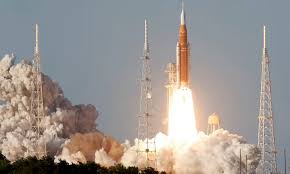
NASA’s Artemis II mission, featuring the Space Launch System (SLS) and the Orion spacecraft, launches from Kennedy Space Center on April, as it begins its crewed journey around the Moon. — Reuters
The NASA has successfully launched its Artemis II mission, marking a significant milestone in the return of human spaceflight beyond Earth’s orbit. The mission lifted off from Kennedy Space Center and represents the first crewed flight of the Artemis program.
The launch vehicle, the Space Launch System (SLS), carried the Orion spacecraft into orbit before initiating its trajectory toward the Moon. This mission is designed as a full-scale test of systems required for future lunar landings.
A Strategic Step Toward Lunar Exploration
Artemis II is a non-landing mission focused on validating deep-space technologies, including life support systems, navigation, and manual spacecraft control. It serves as a critical precursor to upcoming missions that aim to return humans to the lunar surface.
The Artemis program builds upon the legacy of the Apollo program but differs in its long-term objective: establishing a sustainable human presence on the Moon. NASA plans to target the lunar south pole, a region believed to contain water ice and other valuable resources.
International Crew on Board
The Artemis II crew includes four astronauts:
- Reid Wiseman
- Victor Glover
- Christina Koch
- Jeremy Hansen
This marks a step forward in international collaboration, with Canada contributing to the broader Artemis initiative.
Extending the Limits of Human Spaceflight
The mission is expected to travel approximately 406,000 kilometers from Earth, surpassing previous records set during the Apollo 13 mission. This will make Artemis II the farthest distance humans have traveled in space.
The extended range allows NASA to test spacecraft systems under deep-space conditions, including radiation exposure and communication latency—key challenges for future missions to Mars.
Increasing Role of Private Space Companies
The Artemis program reflects a shift in the aerospace sector, with NASA increasingly partnering with private companies such as SpaceX and Blue Origin. These companies are developing lunar landing systems and related technologies to support future missions.
This public-private collaboration is intended to accelerate innovation while reducing the overall cost of space exploration.
Renewed Global Competition in Space
The mission also comes amid intensifying global competition. The United States is working to advance its lunar program ahead of China, which has announced plans for a crewed Moon mission by 2030.
This emerging space race extends beyond exploration, encompassing technological leadership, strategic positioning, and access to extraterrestrial resources.
What Comes Next
Artemis II will be followed by additional missions aimed at refining technologies and operational readiness for a human landing. These steps are essential before astronauts can safely return to the lunar surface later this decade.
If successful, the Artemis program will establish the foundation for long-term lunar exploration and serve as a gateway for future missions to Mars.
Related Articles

Cosmic Byte Drakon Review – The Ultimate Tri-Mode Gaming Controller Under ₹5,000?
Discover the Cosmic Byte Drakon gaming controller with tri-mode connectivity, TMR joysticks, mechanical buttons, and pro-level customization. Full review, features, and performance breakdown.

MacBook Buying Guide 2026: Neo vs Air vs Pro – Which One Should You Buy?
MacBook Buying Guide 2026: Neo vs Air vs Pro – Which One Should You Buy?

Govt Unveils New Housing Loan Plan to Own a House for Just Rs. 16,500 Per Month
Govt Unveils New Housing Loan Plan to Own a House for Just Rs. 16,500 Per Month